
How Much Does Boat Detailing Cost in Myrtle Beach?
Search “how much does boat detailing cost” and you get national averages that don’t mean much at a Grand Strand dock. Here’s what detailing actually runs around Myrtle Beach, why one boat costs more than another, and how to tell whether the quote in front of you is fair.
Reel Clean details boats full time from Georgetown up through the Brunswick beaches. We’d rather you know the numbers before you call anyone, us included.
The short answer: what does boat detailing cost on the Grand Strand?
These are typical mobile detailing rates by boat length.
| Boat size | Wash & wax | Full detail | Oxidation removal* |
|---|---|---|---|
| Under 20 ft | $150 to $225 | $250 to $300 | $800 to $1,500+ |
| 20 to 25 ft | $175 to $300 | $300 to $400 | $1,000 to $2,000+ |
| 26 to 30 ft | $225 to $360 | $400 to $475 | $1,200 to $2,800+ |
| 31 to 40 ft | $280 to $480 | $475 to $625 | $1,500 to $3,500+ |
| 40 to 50 ft | $375 to $600 | $625 to $800 | $2,500 to $5,000+ |
| 50 ft and up | Quoted per boat | Quoted per boat | Quoted per boat |
*Oxidation pricing depends on how bad it is and how many correction steps the finish needs.
These ranges are for licensed, insured work with marine-specific products. If a quote comes in well under them, the scope is probably smaller than you think or corners are getting cut.
Own something 40 feet or longer that sits while you’re out of town? Our yacht management keeps it checked, washed and fueled between trips.
What’s the difference between a wash, a detail and oxidation removal?
Wash & wax
This is maintenance. A freshwater rinse, an exterior wash, a layer of wax or sealant and a wipe-down inside. It’s the right call for a boat that’s already in good shape. It won’t fix oxidation, heavy staining, faded gelcoat or a boat that’s been sitting neglected.
Full detail
A full detail goes a lot deeper. On top of the wash, it covers polishing the stainless, removing hull yellowing, mold and mildew, black streaks, scuffs and rust stains, cleaning and conditioning the vinyl, cleaning the windows and detailing the whole interior. Most boats on the Grand Strand need one every three to six months.
See our full boat detailing service
Oxidation removal
If the hull looks chalky, faded or dull, a detail won’t bring it back. Depending on how far it’s gone, the fix is polishing, buffing or wet sanding. Buffing alone on deep oxidation looks good for a week or two, then the fade comes right back.
Light oxidation might take two correction steps. A hull that’s been neglected for years might take three or four, including sanding. The hull and the topsides don’t always need the same number of steps. Each step is priced by the foot.
A proper oxidation job includes the detail. If someone charges you a full detail on top of it, you’re paying twice.
See our oxidation removal and gelcoat restoration
Get a quote for your boat.
Send us the make, length and condition, and we’ll give you a straight number. No obligation.
Get a free estimateWhat drives the price up or down?
Boat size and hull style
Size is the biggest factor, and most detailers price by the foot. Hull style matters too. A bowrider has less surface than a deck boat the same length, and a center console is a different job from a cabin cruiser.
Current condition
A boat that gets regular care takes a lot less time than one that’s been let go. Heavy oxidation, mold inside, salt buildup and stained vinyl all add hours. That’s why the only fair way to price a detail is to look at the boat first.
Where the boat is kept
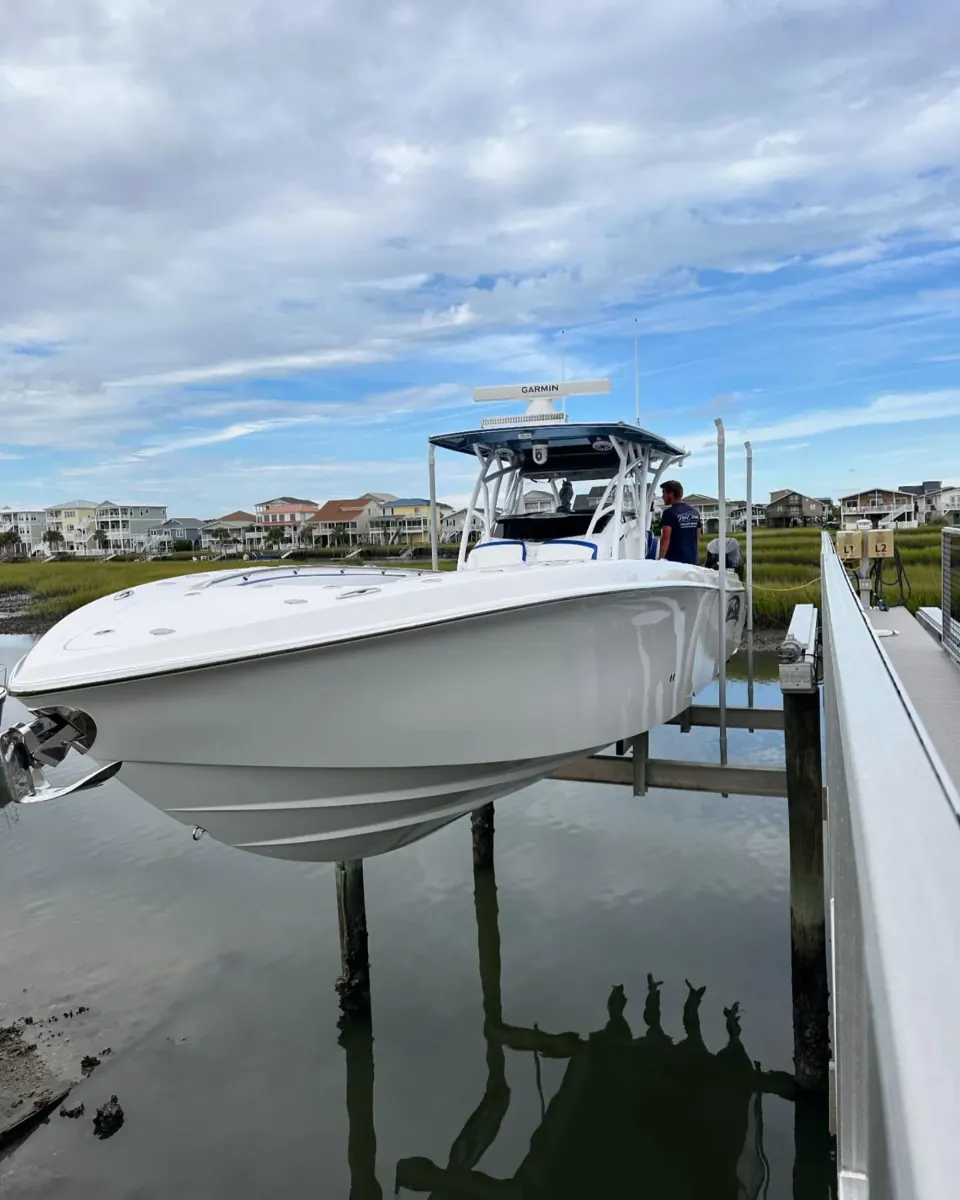
A boat in a wet slip on the Intracoastal picks up more growth, harder water lines and more salt than one in dry stack, on a lift or on a trailer. Boats kept in the water full time usually need more aggressive cleaning and more frequent visits.
Number of correction steps
This is the biggest swing in oxidation work. Light fading might only need two steps, a buff and a polish. A heavily oxidized hull can need four: wet sand, compound, buff and polish. That’s why oxidation work on bigger boats runs anywhere from about $1,000 to well over $5,000.
Add-on services
Common add-ons around the Grand Strand and what they usually run:
- Ceramic coating: $1,500 to $4,000+ depending on size. On bigger boats the hull and topsides may be priced separately. It protects for one to three years depending on storage and upkeep.
- Teak cleaning and restoration: $500 to $2,000+, depending on how much teak there is, its condition and whether it needs light sanding.
- Engine bay degreasing: $250 to $500+.
- Canvas and Bimini deep clean: $300 to $600+, depending on how much there is and how bad the mildew is.
- Hull cleaning below the waterline: $400 to $1,000+, depending on growth. Usually done by a dive service.
Mobile vs. shop
Mobile detailing costs about the same as a shop for most boat sizes, because a mobile operator isn’t paying for a building. The difference is convenience. Our enclosed trailer brings the water, power and equipment to the boat, so you don’t have to hook up, haul it anywhere or come back to pick it up.
The real cost of neglect
New gelcoat costs roughly 10 times what it costs to restore and maintain the gelcoat you already have. Every correction takes off a thin layer. Let it go long enough and there’s not enough left to correct, and now you’re looking at a respray that runs into the thousands.
Regular details and a sealant or ceramic coating keep you out of that spot, and they hold up the boat’s resale value.
What should you be skeptical of?
Quotes that seem too low
A $150 “full detail” on a 28-foot boat isn’t a full detail. Ask whether the price includes the stainless, hull yellowing, mold and stain treatment and the interior.
Oxidation removal that’s just a buff
Buffing alone won’t handle moderate or heavy oxidation. Ask what process they use and why.
No license or insurance
Anyone working on a boat at a marina should be licensed and insured. If something gets damaged or there’s a billing dispute, you need someone to go back to. Reel Clean is licensed and insured.
A flat rate without seeing the boat
A price over the phone with no photos and no look at the boat is a red flag. It’s either a lowball that turns into upsells, or it’s padded to cover whatever they can’t see.
A separate detail charge on top of oxidation removal
Charging a full detail on top of multi-step oxidation correction is billing you twice.
Is boat detailing worth the cost?
For most owners, yes. Unprotected gelcoat can start oxidizing in a single season of Carolina sun and salt, and the fix gets more expensive every year you wait. Remember that new gelcoat runs about 10 times the cost of keeping up with what you have.
If you want the least upkeep possible, look at marine ceramic coating. It cuts down how often you need a full detail, makes washing faster and protects for one to three years depending on storage and how well you keep up with it.
How often should you detail your boat on the Grand Strand?
A full professional detail every three to six months is a good rule. Here’s how it breaks down by how you use the boat:
- Heavy use, kept in a wet slip: every 3 months
- Moderate use, dry stack or a lift: every 4 to 6 months
- Light use, covered storage: twice a year
If the boat lives in the water or sees a lot of salt, lean toward the more frequent end. Our weekly, biweekly and monthly wash plans help in between, and these four habits keep the finish looking good longer.